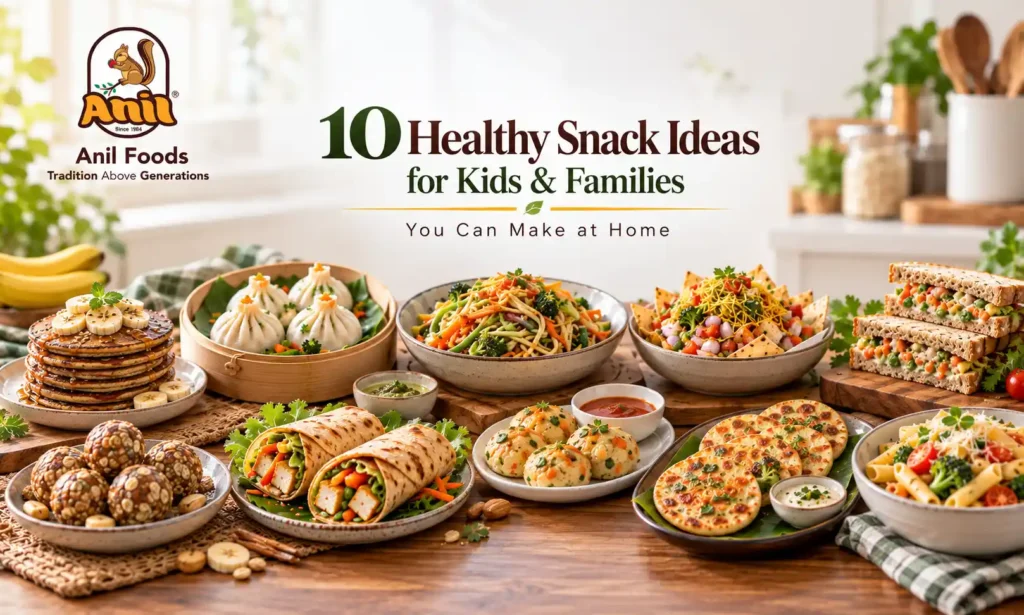
Finding healthy snacks that children actually enjoy can be challenging. The good news is that a nutritious snack does not have to be complicated or time-consuming.
With familiar ingredients such as ragi, vegetables, paneer, peanuts, dosa mix, rava and kozhukattai flour, you can prepare simple homemade snacks for school lunchboxes, after-school hunger or evening family time.
A balanced snack can combine foods from different food groups, such as grains or millets with vegetables, dairy, pulses, nuts or other protein-rich ingredients. The ICMR-National Institute of Nutrition’s Dietary Guidelines for Indians 2024 emphasise variety and balanced food choices across age groups.
In this guide, you will find 10 easy healthy snack ideas that can be prepared at home, along with simple preparation methods and practical tips for making everyday snacks more nutritious.
Nutrition note: The nutritional value of each snack depends on the ingredients, portion size, brand and cooking method. The recipes below are intended as practical food ideas and are not a substitute for individual dietary advice.
Quick List: 10 Healthy Snack Ideas
- Ragi Banana Pancakes
- Steamed Vegetable Kozhukattai
- Homemade Vegetable Noodles
- Roasted Appalam Chaat
- Vegetable Rusk Sandwich
- Peanut and Banana Energy Balls
- Paneer Vegetable Wrap
- Vegetable Rava Upma Bites
- Mini Vegetable Dosa
- Vegetable Pasta
1. Ragi Banana Pancakes
Ragi banana pancakes are an easy way to turn ragi flour and ripe banana into a soft, naturally sweet snack.
Ragi, also known as finger millet, is widely used in Indian cooking and can be used in pancakes, dosa, porridge and other homemade recipes. Banana adds natural sweetness, while milk contributes protein and calcium.
For another way to include millet-based foods in your diet, explore our detailed guide on millet and its types, nutrition.
Ingredients
- 1 cup ragi flour
- 1 ripe banana
- ½ cup milk
- A small amount of jaggery, if required
- A pinch of cardamom
- A little oil or ghee for cooking
How to Make Ragi Banana Pancakes
- Mash the ripe banana in a bowl.
- Add ragi flour and milk.
- Mix until you get a smooth batter.
- Add a small amount of jaggery if additional sweetness is required.
- Add cardamom.
- Heat a pan and lightly grease it.
- Pour a small portion of batter onto the pan.
- Cook on both sides until done.
- Serve warm.
Why Add Ragi to Homemade Snacks?
Ragi can add variety to a child’s grain intake and is particularly known for its calcium content. However, a healthy snack should not depend on one ingredient alone. Pairing ragi with fruit, dairy or other nutritious foods can create a more varied snack.
2. Steamed Vegetable Kozhukattai
Kozhukattai is a traditional South Indian food that can be prepared in both sweet and savoury versions.
For a savoury snack, combine the rice-based outer layer with vegetables such as carrot and green peas. Since the kozhukattai is steamed rather than deep-fried, it can be a convenient option when you want to reduce the amount of cooking oil used.
Ingredients
- 1 cup kozhukattai flour
- Water
- 1 carrot, finely chopped
- ¼ cup green peas
- 2 tablespoons grated coconut
- Curry leaves
- A small amount of salt
- 1 teaspoon oil
How to Make Vegetable Kozhukattai
- Boil water with a small amount of salt.
- Slowly add kozhukattai flour while stirring.
- Mix until a soft dough forms.
- Allow the mixture to cool slightly.
- Add finely chopped vegetables and grated coconut.
- Mix everything well.
- Shape the mixture into small balls.
- Place the balls in a steamer.
- Steam for around 10–15 minutes or until cooked.
- Allow them to cool slightly before serving.
Why It Works as a Snack
Steaming allows you to prepare the snack with little added oil. Vegetables also add colour, texture and nutrients.
3. Homemade Vegetable Noodles
Noodles can be included in a homemade snack when you build the recipe around plenty of vegetables and a sensible amount of oil.
Instead of making noodles the only ingredient, add vegetables such as carrot, cabbage, capsicum and spring onion.
Ingredients
- Noodles
- 1 carrot, sliced
- ½ cup cabbage
- ½ capsicum
- 1 small onion
- Spring onion
- Black pepper
- A small amount of cooking oil
- A small amount of salt
How to Make Vegetable Noodles
- Cook the noodles according to the package instructions.
- Drain and keep them aside.
- Heat a pan and add a small amount of oil.
- Add onion and sauté briefly.
- Add carrot, cabbage and capsicum.
- Stir-fry the vegetables until slightly tender while retaining some texture.
- Add the cooked noodles.
- Season with pepper and a small amount of salt.
- Toss everything together.
- Serve warm.
How to Make Noodles More Balanced
The easiest way to improve a noodle snack is to increase the proportion of vegetables and add an appropriate protein source when suitable, such as paneer, egg, tofu or cooked pulses.
This makes the dish more varied instead of relying mainly on noodles.
4. Roasted Appalam Chaat
Want something crispy without deep-frying? Try turning roasted appalam into a quick vegetable chaat.
The basic idea is simple: roast the appalam, break it into pieces and combine it with fresh vegetables and a protein-rich ingredient such as chickpeas or sprouts.
Ingredients
- Appalam
- 1 small tomato, chopped
- 1 small onion, chopped
- ½ cucumber, chopped
- ½ cup boiled chickpeas or sprouts
- Fresh coriander
- Lemon juice
- A small amount of salt
How to Make Appalam Chaat
- Roast the appalam on a pan or over a flame.
- Break it into small pieces.
- Add chopped tomato, onion and cucumber to a bowl.
- Add boiled chickpeas or sprouts.
- Add the roasted appalam.
- Add coriander and lemon juice.
- Mix gently.
- Serve immediately to retain the crunch.
Simple Snack Upgrade
The appalam provides the crunchy element, while vegetables and chickpeas or sprouts add more variety to the snack.
You can also adjust the amount of salt and seasoning according to your family’s preferences.
5. Vegetable Rusk Sandwich
Rusk is usually served with tea or milk, but it can also become the base for a quick vegetable snack.
Adding paneer or hung curd and fresh vegetables gives the rusk a more substantial filling.
Ingredients
- Rusk
- Paneer or hung curd
- Grated carrot
- Cucumber
- Tomato
- Black pepper
- Fresh coriander
How to Make a Vegetable Rusk Sandwich
- Prepare a filling using paneer or hung curd.
- Add grated carrot, cucumber and tomato.
- Season with pepper and coriander.
- Spread the filling over one rusk.
- Place another rusk on top.
- Cut into smaller pieces if required.
- Serve immediately.
Make It More Nutritious
Look for options that fit your family’s dietary needs, and use vegetables generously in the filling.
Paneer or curd can also contribute protein and calcium to the snack.
6. Peanut and Banana Energy Balls
Peanut and banana energy balls are convenient when you need a quick homemade snack.
Peanuts provide protein and fats, while banana and oats provide carbohydrates and fibre. Dates can help bind the mixture while adding sweetness.
Ingredients
- ½ cup roasted peanuts
- 1 ripe banana
- ½ cup oats
- 3–4 soft dates
- A pinch of cardamom
How to Make Peanut and Banana Energy Balls
- Grind the roasted peanuts into a coarse mixture.
- Mash the banana separately.
- Add oats and finely chopped or mashed dates.
- Combine all the ingredients.
- Mix until the mixture becomes easy to shape.
- Form small balls using clean hands.
- Refrigerate briefly before serving.
Portion Tip
Energy balls can be compact and filling, so small portions are usually sufficient for a snack. The exact ingredients can also be adjusted according to age, dietary requirements and family preferences.
Important: Whole or chopped nuts may not be suitable for very young children because of choking risk. Use age-appropriate textures and follow appropriate feeding guidance.
7. Paneer Vegetable Wrap
A paneer vegetable wrap is a convenient after-school snack that combines a grain-based wrap with paneer and vegetables.
It can also be prepared in advance and cut into small portions for easier serving.
Ingredients
- 1 chapati or whole-wheat wrap
- Paneer
- Carrot
- Capsicum
- Cucumber
- Onion
- Black pepper
- A small amount of curd
How to Make a Paneer Vegetable Wrap
- Cut the paneer into small pieces.
- Lightly cook the paneer with vegetables.
- Place the chapati or wrap on a plate.
- Add the paneer and vegetable filling.
- Add a small amount of curd.
- Roll the wrap tightly.
- Cut into smaller pieces if required.
- Serve warm or pack appropriately.
Why It Makes a Convenient Snack
Paneer adds protein and calcium, while vegetables contribute fibre and micronutrients. Using a whole-wheat wrap can also add variety to the grain component.
8. Vegetable Rava Upma Bites
Rava, also called semolina or sooji, is a versatile ingredient for quick homemade snacks.
Turning vegetable upma into small bite-sized portions makes it easier to serve as a school or after-school snack.
Ingredients
- 1 cup roasted rava
- ½ cup mixed vegetables
- 1 small onion
- 1 teaspoon oil
- Mustard seeds
- Curry leaves
- Water
- A small amount of salt
How to Make Rava Upma Bites
- Heat a pan and add a little oil.
- Add mustard seeds and curry leaves.
- Add chopped onion and sauté.
- Add the vegetables and cook until slightly soft.
- Add water and bring it to a boil.
- Slowly add roasted rava while stirring continuously.
- Cook until the mixture thickens.
- Allow it to cool slightly.
- Shape the upma into small bite-sized portions.
Lunchbox Tip
Prepare smaller pieces that are easy to hold and eat. You can serve them with homemade chutney or curd, depending on the child’s preference.
9. Mini Vegetable Dosa
Dosa is a familiar Indian favourite and can easily be adapted into a convenient snack.
Using a ready dosa mix can reduce preparation time, particularly on busy mornings. Adding finely chopped vegetables also gives the snack more variety.
Ingredients
- Dosa mix
- Carrot
- Onion
- Capsicum
- Coriander leaves
- Water
- A small amount of oil
How to Make Mini Vegetable Dosa
- Prepare the dosa batter according to the package instructions.
- Finely chop the vegetables.
- Add the vegetables and coriander to the batter.
- Heat a dosa pan.
- Pour small portions of batter onto the pan.
- Spread into mini dosas.
- Add a few drops of oil.
- Cook until the edges become crisp and the dosa is cooked through.
- Serve with chutney or another suitable accompaniment.
Try Different Millet Dosa Mixes
You can add variety by rotating different dosa mixes rather than preparing the same snack every time.
Anil Foods currently offers Ragi Dosa Mix, Kambu Dosa Mix, Thinai Dosa Mix, Varagu Dosa Mix and Cholam Dosa Mix, along with other dosa-mix options.
10. Vegetable Pasta
Pasta can become a colourful homemade snack when combined with a generous portion of vegetables.
This can be particularly useful for children who prefer familiar Western-style foods.
Ingredients
- Pasta
- Carrot
- Capsicum
- Sweet corn
- Onion
- Tomato
- A small amount of cooking oil
- Black pepper
- A small amount of salt
How to Make Vegetable Pasta
- Cook the pasta according to the package instructions.
- Drain and keep aside.
- Heat a pan and add a small amount of oil.
- Add onion and cook until soft.
- Add carrot, capsicum and sweet corn.
- Add tomato and cook until the vegetables are tender.
- Add the cooked pasta.
- Season with pepper and a small amount of salt.
- Mix well.
- Serve warm.
Simple Way to Improve the Recipe
Use more vegetables and consider adding an appropriate protein source if desired. The goal is to make the snack more varied rather than relying mainly on pasta.
How to Make School Snacks Healthier
A nutritious snack is not simply about finding one ingredient labelled as “healthy”. The overall combination of foods, cooking method, portion size and frequency all matter.
The WHO describes a healthy diet around four principles: adequacy, balance, moderation and diversity, while the ICMR-NIN Dietary Guidelines for Indians 2024 provide India-specific dietary guidance.
Here are practical ways to improve everyday snacks.
1. Add More Vegetables
Carrot, cucumber, peas, beans, capsicum, tomato and sweet corn can be added to many homemade snacks.
Try adding vegetables to:
- Dosa
- Noodles
- Pasta
- Upma
- Wraps
- Chaat
- Sandwiches
2. Include a Protein Source
Depending on the child’s age, dietary preferences and nutritional requirements, snacks can include foods such as:
- Paneer
- Curd
- Milk
- Peanuts
- Chickpeas
- Sprouts
- Pulses
- Eggs
- Other suitable protein-rich foods
The aim is to create variety rather than relying on a single nutrient.
3. Use Traditional Grains and Millets
Traditional ingredients such as ragi, kambu, thinai, varagu and cholam can add variety to everyday meals and snacks.
Millets can be used in dosa, pancakes, porridge and other familiar dishes.
4. Choose the Cooking Method Carefully
The same basic ingredient can result in very different snacks depending on how it is prepared.
Where appropriate, consider:
- Steaming
- Roasting
- Pan-cooking
- Baking
- Grilling
Use deep-frying less often when a suitable alternative works for the recipe.
5. Be Mindful of Added Sugar
Fruit can add sweetness to several homemade snacks.
Banana, dates and other naturally sweet ingredients can be useful in recipes where appropriate, while added sugar can be adjusted according to the recipe and dietary needs.
6. Watch the Amount of Salt and Oil
Reducing excess salt and oil can help make everyday homemade snacks more suitable for a balanced eating pattern.
This does not mean removing them completely. Focus on sensible quantities and overall dietary variety.
7. Offer Variety
Instead of serving the same snack every day, rotate different food groups and recipes.
For example:
Monday: Mini vegetable dosa
Tuesday: Ragi banana pancake
Wednesday: Paneer vegetable wrap
Thursday: Vegetable upma bites
Friday: Steamed kozhukattai
This keeps snack time interesting while exposing children to different foods.
8. Keep Portions Age-Appropriate
Children do not all need the same amount of food.
Snack portions can depend on age, activity level, appetite and what the child is eating during the rest of the day.
A snack should generally complement regular meals rather than replace them.
Healthy Snack Ideas for School Lunchboxes
When choosing a school snack, convenience matters as much as the recipe.
Look for foods that are:
- Easy to hold and eat
- Suitable for the child’s age
- Not excessively messy
- Easy to pack
- Prepared with safe food-handling practices
- Varied across the week
Some options from this guide include:
| Snack | Why It Works for Lunchboxes |
|---|---|
|
Mini vegetable dosa |
Small and easy to portion
|
|
Ragi banana pancakes |
Soft and easy to eat |
|
Paneer vegetable wrap |
Convenient handheld option
|
|
Vegetable upma bites
|
Easy to portion |
|
Steamed kozhukattai |
Soft and filling
|
|
Peanut banana balls |
Compact homemade snack
|
Always consider your school’s food policies and your child’s individual dietary requirements.
Healthy Evening Snacks for Kids
After school, children may be hungry after classes, sports or other activities.
Instead of serving the same packaged snack every day, rotate homemade options such as:
- Ragi banana pancakes
- Mini vegetable dosa
- Paneer vegetable wraps
- Vegetable noodles
- Vegetable pasta
- Steamed kozhukattai
- Vegetable rava bites
- Chickpea or vegetable chaat
For a broader selection of Indian snack ideas, explore Anil Foods’ related guide to healthy Indian snacks for families.
Are Homemade Snacks Better Than Packaged Snacks?
Homemade snacks can make it easier to control the ingredients and cooking method. You can decide how much oil, salt or added sugar goes into a recipe and increase the amount of vegetables or other nutritious ingredients.
However, packaged foods are not automatically unsuitable, and homemade food is not automatically nutritious.
The overall ingredients, portion size, preparation method and frequency matter.
The goal should be to build a varied eating pattern rather than treating individual foods as simply “good” or “bad”.
Frequently Asked Questions
1. What are some healthy snack ideas for kids?
Some easy options include ragi banana pancakes, vegetable dosa, paneer wraps, steamed kozhukattai, vegetable pasta, vegetable noodles, rava bites and homemade energy balls.
2. What is a good healthy school snack?
A practical school snack can combine a grain or millet-based food with vegetables, fruit, dairy, pulses, nuts or another suitable protein source. Mini dosa, ragi pancakes, vegetable wraps and steamed snacks are convenient options.
3. What are some easy healthy evening snacks?
Ragi pancakes, vegetable dosa, paneer wraps, vegetable noodles, vegetable pasta and steamed kozhukattai are simple homemade choices for evening snack time.
4. Are homemade snacks healthier than packaged snacks?
Homemade snacks allow you to control ingredients such as oil, salt and added sugar. However, the nutritional quality of any snack depends on its ingredients, preparation and portion size.
5. Which snacks can provide protein?
Protein can come from ingredients such as paneer, curd, peanuts, chickpeas, sprouts, pulses, eggs and other suitable foods. Adding one of these ingredients to a grain- or vegetable-based snack can make the overall snack more varied.
6. How can I make noodles healthier?
Add plenty of vegetables and use a sensible amount of oil and seasoning. You can also add an appropriate protein source such as paneer, egg, tofu or cooked pulses.
7. Are millet-based snacks good for children?
Millets can be included in children’s diets as part of a varied and balanced eating pattern. Ragi, for example, can be used in pancakes, dosa and other familiar recipes. The overall meal or snack still needs variety.
8. What are some healthy Indian snacks for school?
Mini vegetable dosa, ragi pancakes, steamed kozhukattai, vegetable upma bites and paneer wraps are practical Indian-inspired options.
9. How can I reduce oil when making snacks?
Try steaming, roasting, baking, grilling or pan-cooking where suitable. When pan-cooking, use only the amount of oil needed for the recipe.
10. How often should children eat snacks?
There is no single snack schedule that works for every child. Snack timing and portion size can vary depending on age, appetite, activity level and the child’s regular meals.
If you have concerns about a child’s nutrition, growth or dietary requirements, consult a qualified paediatrician or registered dietitian.
Final Thoughts
Healthy snacking does not have to mean complicated recipes or unfamiliar ingredients.
Simple foods such as ragi, vegetables, paneer, peanuts, rava, dosa mix and kozhukattai flour can be used to create interesting homemade snacks for school, after-school hunger and family tea time.
The key is variety. Rotate different grains, vegetables, fruits, pulses, dairy foods, nuts and other suitable ingredients instead of depending on one recipe every day.
You can also make familiar favourites such as noodles, pasta and dosa more balanced by adding vegetables and paying attention to cooking methods and portions.
For more practical food ideas, explore the Anil Foods collection of millet recipes, traditional Indian recipes and healthy snack ideas.
Table of Contents