
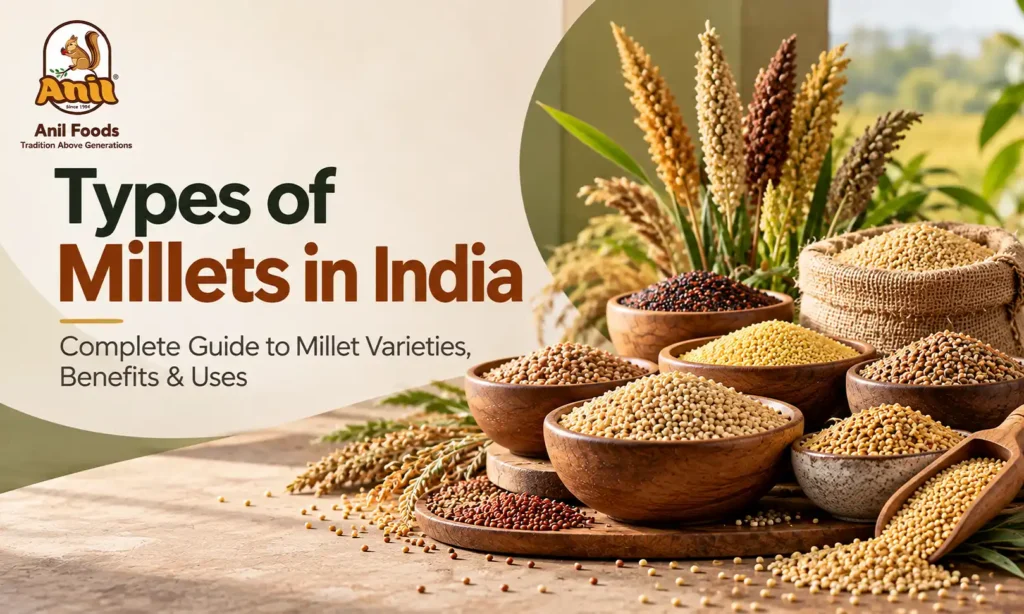
Millets have always had a place in Indian kitchens. Long before they became a popular health-food choice, people were making ragi porridge, kambu koozh, jowar roti, thinai pongal and varagu upma at home.
What makes millets interesting is that there isn’t just one type. India has several millet varieties, and each one has its own taste, texture, appearance, nutritional profile and traditional uses.
The most commonly known Indian millet varieties include ragi, pearl millet, sorghum, foxtail millet, kodo millet, little millet, barnyard millet, proso millet and browntop millet. IIMR currently lists these crops in its millet resources, while FSSAI’s guidance identifies the major and small millet groups.
In this guide, we’ll look at the different types of millets in India, what they are called in different regions, their key nutritional characteristics and the dishes they are commonly used for.
Already want to know more about millets in general? Read our complete guide to millets to learn about their nutritional benefits, uses and role in everyday cooking.
Types of Millets in India at a Glance
Before looking at each variety in detail, here is a quick comparison of the commonly used Indian millets.
| Millet | Common Name | Tamil Name | Popular Uses |
|---|---|---|---|
|
Finger Millet
|
Ragi
|
Kelvaragu / Ragi
|
Dosa, porridge, idli, roti |
|
Pearl Millet
|
Bajra |
Kambu |
Roti, koozh, dosa
|
|
Sorghum
|
Jowar |
Cholam
|
Roti, dosa, porridge
|
|
Foxtail Millet
|
Kangni |
Thinai
|
Upma, pongal, dosa
|
|
Kodo Millet
|
Kodo |
Varagu |
Pongal, upma, dosa |
|
Little Millet
|
Kutki |
Samai
|
Pongal, upma, dosa
|
|
Barnyard Millet
|
Sanwa |
Kuthiraivali |
Upma, pongal, rice-style dishes |
|
Proso Millet
|
Cheena |
Panivaragu |
Porridge, upma, rice-style dishes
|
|
Browntop Millet
|
Korale |
Regional names vary
|
Upma, porridge, dosa
|
Names can vary from one state or language to another. Indian Institute of Millets Research’s regional-name information, for example, lists Kambu for pearl millet in Tamil, Kelvaragu for finger millet, Varagu for kodo millet and Samai for little millet.
1. Ragi – Finger Millet
Ragi, also known as finger millet, is one of the most familiar millets in South India. In Tamil, it is commonly called Kelvaragu or Ragi.
It has a reddish-brown colour and a naturally earthy taste. Ragi is available as whole grain as well as flour, which makes it particularly useful in everyday cooking.
Ragi is well known for its calcium content.
Common Uses of Ragi
Ragi is commonly used to make:
- Ragi dosa
- Ragi idli
- Ragi roti
- Ragi porridge
- Ragi malt
- Ragi mudde
- Ragi snacks
- Ragi vermicelli
Its flour also works well in recipes where you want to add a distinctly earthy millet flavour.
2. Bajra – Pearl Millet
Pearl millet, commonly called Bajra in Hindi and Kambu in Tamil, is another traditional Indian millet.
It has a slightly nutty flavour and is particularly popular in regions where millet-based flatbreads are part of the local cuisine.
For a more detailed look at this variety, read our guide to pearl millet benefits and nutrition.
Common Uses of Pearl Millet
- Bajra roti
- Kambu koozh
- Kambu dosa
- Kambu adai
- Pearl millet porridge
- Millet-based snacks
3. Jowar – Sorghum
Sorghum, widely known as Jowar, is called Cholam in Tamil.
Unlike some of the smaller millets, sorghum has relatively larger grains and can be cooked whole or ground into flour.
It has a mild, slightly earthy flavour and works well in both traditional recipes and newer millet-based foods.
Common Uses of Sorghum
Sorghum can be used to prepare:
- Jowar roti
- Cholam dosa
- Sorghum porridge
- Whole-grain dishes
- Millet snacks
- Flour-based recipes
4. Thinai – Foxtail Millet
Foxtail millet is traditionally known as Thinai in Tamil. It is one of the small millets commonly used in South Indian cooking.
The tiny grains have a mild, slightly nutty taste and can be cooked much like rice. This makes Thinai an easy choice for dishes such as pongal and upma.
Common Uses of Foxtail Millet
- Thinai upma
- Thinai pongal
- Foxtail millet dosa
- Foxtail millet idli
- Millet bowls
- Thinai rice-style dishes
- Millet vermicelli
5. Varagu – Kodo Millet
Kodo millet, called Varagu in Tamil, is another traditional small millet.
It has a mild flavour and can be cooked as a whole grain. Because of its texture after cooking, it works particularly well in dishes that are usually prepared with rice.
Common Uses of Kodo Millet
- Varagu pongal
- Kodo millet upma
- Kodo millet dosa
- Rice-style dishes
- Millet bowls
- Millet salads
6. Samai – Little Millet
Little millet, known as Samai in Tamil, is a small-grained millet with a mild flavour.
It is a useful option for people who want to experiment with millets without changing the style of their usual meals too much.
Common Uses of Little Millet
- Samai pongal
- Samai upma
- Samai rice-style dishes
- Millet dosa
- Millet idli
- Millet bowls
- Salads
7. Kuthiraivali – Barnyard Millet
Barnyard millet is known as Kuthiraivali in Tamil and Sanwa in Hindi.
It is another small millet that can be cooked and served in a similar way to rice. Its nutritional profile also makes it an interesting addition to a varied diet.
Common Uses of Barnyard Millet
- Kuthiraivali upma
- Barnyard millet pongal
- Millet dosa
- Millet idli
- Rice-style dishes
- Millet bowls
8. Panivaragu – Proso Millet
Proso millet, known as Panivaragu in Tamil, is not as familiar to many households as ragi or bajra, but it is another traditional millet variety grown and used in India.
It can be cooked as a whole grain or ground into flour.
Common Uses of Proso Millet
- Porridge
- Upma
- Rice-style dishes
- Dosa
- Flour-based recipes
9. Browntop Millet
Browntop millet, also known by the regional name Korale, is another small millet included in IIMR’s millet resources.
It is less commonly seen in everyday cooking than ragi, pearl millet or sorghum, but it can be used in many of the same ways as other small millets.
Common Uses of Browntop Millet
Depending on availability, it can be used for:
- Upma
- Porridge
- Dosa
- Millet bowls
- Rice-style dishes
Millet Names in Different Indian Languages
One reason millet varieties can sometimes be confusing is that the same grain may have a different name in another part of India.
| Millet | Common/Hindi Name | Tamil | Telugu | Kannada |
|---|---|---|---|---|
|
Finger Millet
|
Ragi / Mandua |
Kelvaragu
|
Ragi |
Ragi |
|
Pearl Millet
|
Bajra |
Kambu |
Sajjalu
|
Sajje
|
|
Sorghum
|
Jowar |
Cholam
|
Jonna
|
Jola |
|
Foxtail Millet
|
Kangni |
Tenai / Thinai
|
Korra
|
Navane |
|
Kodo Millet
|
Kodo |
Varagu |
Arikelu / Arika
|
Harka |
|
Little Millet
|
Kutki |
Samai
|
Samalu |
Same / Save |
|
Barnyard Millet
|
Sanwa |
Kuthiraivali |
Udalu |
Oodalu |
|
Proso Millet
|
Cheena / Chena
|
Panivaragu |
Variga |
Baragu
|
|
Browntop Millet
|
Korale |
Regional names vary
|
Regional names vary
|
Korale
|
The exact spelling and pronunciation can vary between regions, so product labels can be useful when buying packaged millet products. IIMR provides multilingual names for these millet varieties.
Nutritional Benefits of Different Millet Varieties
Millets are often spoken about as if they are nutritionally identical, but they are not. Each variety has its own nutritional profile.
The following values are reference values reported by the Indian Institute of Millets Research (IIMR). Nutrient values can vary with variety, growing conditions, processing and preparation.
| Millet | Protein | Fibre | Iron | Calcium |
|---|---|---|---|---|
|
Ragi
|
7.3 g
|
3.6 g
|
3.9 mg
|
344 mg
|
|
Pearl Millet
|
10.6 g
|
1.3 g
|
16.9 mg
|
38 mg
|
|
Sorghum
|
10 g |
4 g |
2.6 mg
|
54 mg
|
|
Foxtail Millet
|
12.3 g
|
8 g
|
2.8 mg
|
31 mg
|
|
Kodo Millet
|
8.3 g
|
9 g
|
0.5 mg
|
27 mg
|
|
Little Millet
|
7.7 g
|
7.6 g
|
9.3 mg
|
17 mg
|
|
Barnyard Millet
|
11.2 g
|
10.1 g
|
15.2 mg
|
11 mg
|
|
Proso Millet
|
12.5 g
|
2.2 g
|
0.8 mg
|
14 mg
|
|
Browntop Millet
|
11.5 g
|
12.5 g
|
0.65 mg
|
— |
Rather than asking which millet is the “healthiest”, it is more useful to look at the variety that fits your recipe, taste and dietary needs.
Which Millet Is Best for Different Recipes?
There is no need to use the same millet for every dish. Different varieties work particularly well in different preparations.
| Recipe | Millets to Try |
|---|---|
|
Dosa |
Ragi, Kambu, Thinai, Varagu, Cholam |
|
Roti |
Ragi, Kambu, Jowar
|
|
Pongal
|
Thinai, Varagu, Samai, Kuthiraivali
|
|
Upma
|
Thinai, Varagu, Samai, Kuthiraivali
|
|
Porridge
|
Ragi, Pearl Millet
|
|
Rice-style dishes
|
Thinai, Varagu, Samai, Kuthiraivali
|
|
Vermicelli
|
Millet-based vermicelli
|
This variety is one of the biggest advantages of cooking with millets. You can change the grain without having to completely change the type of meal you enjoy.
How to Include Different Millets in Everyday Meals
You don’t have to make dramatic changes to your diet to start using different millet varieties.
Millet Dosa
Ragi, Kambu, Thinai, Varagu and Cholam can all be used in different dosa preparations.
For a convenient option, explore the Anil Foods Millet Dosa Mix collection, which includes different millet-based dosa mixes.
Millet Upma
Foxtail, little, kodo and barnyard millet work well in upma. Add vegetables, onion, curry leaves and your preferred spices for a simple breakfast.
Millet Pongal
Try Thinai, Varagu or another small millet in place of rice when preparing pongal with moong dal, pepper, cumin and ginger.
Millet Roti
Ragi, pearl millet and sorghum are commonly ground into flour for rotis and other flatbreads.
Millet Vermicelli
Millet-based vermicelli is another easy way to include millet in everyday meals. It can be prepared as vegetable vermicelli, lemon semiya or upma.
You can explore the Anil Foods Millet Vermicelli collection for convenient millet-based options.
How to Choose the Right Millet
India’s millet tradition is much more diverse than a single grain or recipe.
From Ragi, Kambu and Jowar to Thinai, Varagu, Samai, Kuthiraivali, Panivaragu and Browntop millet, each variety brings something different to the kitchen.
Some are especially popular for dosa and porridge, while others work well in roti, pongal, upma and rice-style dishes. Their nutritional profiles also differ, which is another reason to enjoy a variety of grains rather than relying on just one.
If you are new to millets, start with a familiar recipe and one variety. Once you get comfortable with it, try another and see which flavours and textures you enjoy most.
Conclusion
If you are trying millets for the first time, there is no need to buy several varieties at once.
Start with the type that suits the food you already enjoy:
- Like dosa or idli? Try ragi, Thinai or Kambu.
- Prefer roti? Try ragi, pearl millet or jowar.
- Love pongal? Try Thinai, Varagu or Samai.
- Looking for a rice-style dish? Try Kodo, little, barnyard or foxtail millet.
- Want to try something less familiar? Explore proso or browntop millet.
Once you find a variety you like, you can gradually try the others.
Frequently Asked Questions (FAQs)
1. What are the main types of millets in India?
The commonly used millet varieties in India include Ragi, Pearl Millet, Jowar, Foxtail Millet, Kodo Millet, Little Millet, Barnyard Millet, Proso Millet and Browntop Millet.
2. How many types of millets are there in India?
India grows several millet crops, including major millets such as pearl millet and finger millet and small millets such as foxtail, little, kodo, barnyard, proso and browntop millet. Sorghum is also widely discussed alongside millets in Indian food and agricultural resources.
3. Which millet is called Kambu in Tamil?
Kambu is the Tamil name for Pearl Millet, also known as Bajra. It is commonly used to prepare koozh, dosa, roti and other traditional dishes.
4. Which millet is called Cholam in Tamil?
Cholam refers to Sorghum, commonly known as Jowar. It can be used as a whole grain or ground into flour for rotis, dosa and other recipes.
5. Which millet is called Thinai in Tamil?
Thinai is Foxtail Millet. It has a mild, slightly nutty flavour and is commonly used in pongal, upma, dosa and rice-style dishes.
6. Which millet is called Varagu in Tamil?
Varagu is Kodo Millet, a small millet commonly used in pongal, upma, dosa and rice-style preparations.
7. Which millet is called Samai in Tamil?
Samai is Little Millet. Its small grains work well in everyday dishes such as pongal, upma, dosa and rice-style meals.
8. Which millets are commonly used for dosa?
Ragi, Pearl Millet, Foxtail Millet, Kodo Millet and Sorghum can all be used in different types of dosa recipes. The texture and flavour will vary depending on the millet used.
9. Which millets can be used instead of rice?
Foxtail, Kodo, Little and Barnyard millets are commonly used in rice-style dishes. They can also be used for pongal, pulao-style preparations and bowls.
10. Are all types of millets nutritionally the same?
No. Different millet varieties have different nutritional profiles, including differences in protein, fibre, iron and calcium. Choosing a variety of millets can also add more diversity to your meals.
11. Are millets naturally gluten-free?
Most millet grains are naturally gluten-free. However, people who need to strictly avoid gluten should check packaged millet products and preparation environments for possible cross-contact.
Table of Contents